

FREE SHIPPING on purchases over 50 €
*Valid for consumables
How Many Pages Does an Ink or Toner Really Print?
19/12/2025
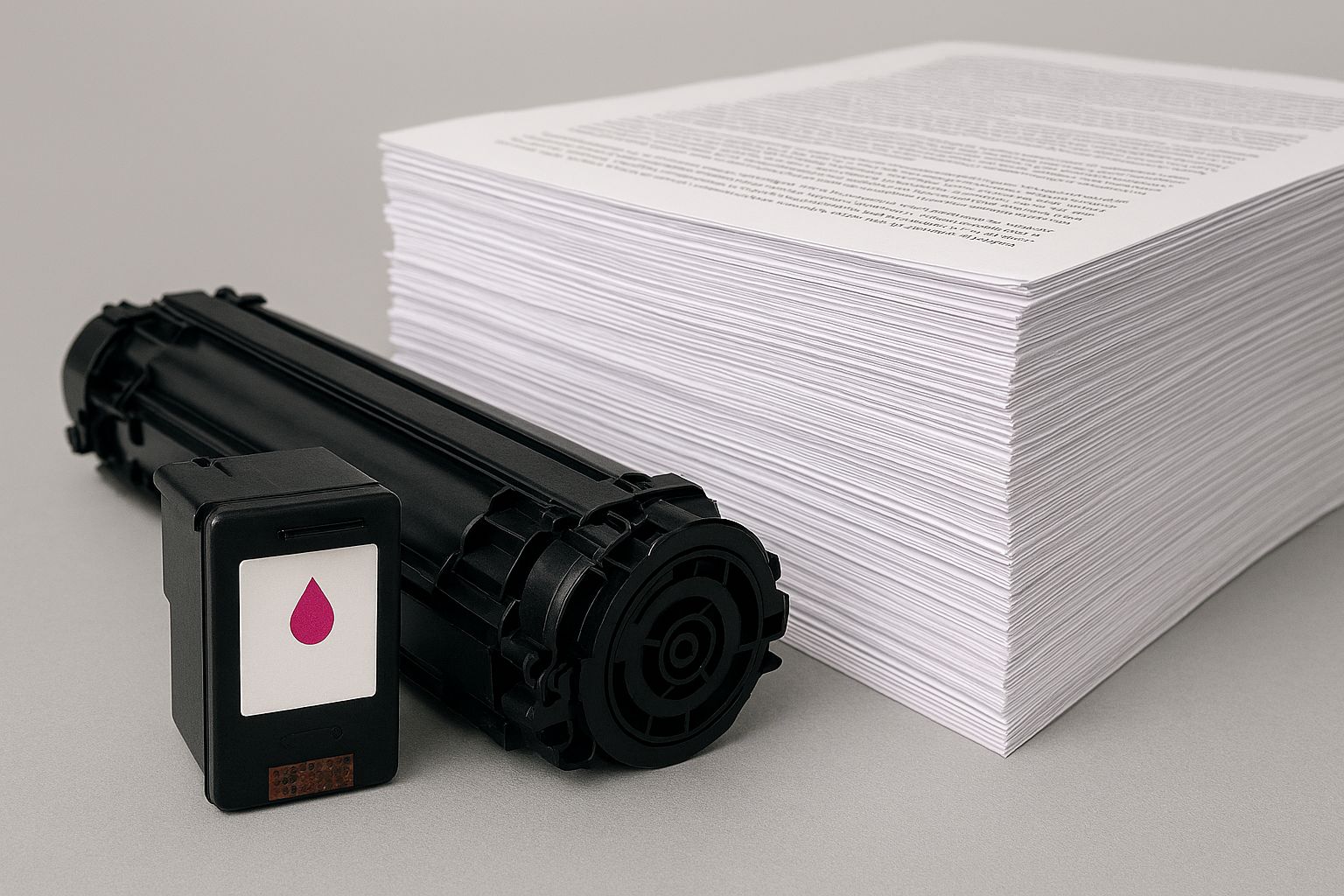
The yield of an ink or toner cartridge is one of the most misunderstood factors when choosing consumables. Most users see a number on the package, such as “2,000 pages,” and assume it reflects real everyday usage. In reality, actual yield can vary significantly depending on what and how you print.
In this detailed guide, we explain what the page count really means, what the famous 5% coverage is, and how you can more realistically estimate how long an ink or toner cartridge will last.
What “Page Yield” Means in Consumables
Page yield is the estimated number of pages a consumable can print before it runs out. This number is not arbitrary. It is calculated based on international testing standards defined by the International Organization for Standardization (ISO).
Tests are conducted in controlled environments, using specific print files and measurable ink or toner consumption. The result is a comparable figure across different manufacturers—but not a promise for every real-world usage scenario.
What Is 5% Coverage and Why It Is Used
5% coverage means that, on average, only 5% of each page’s surface is covered with ink or toner. In practice, this corresponds to a simple text document with a few paragraphs—no images, no heavy graphics, and no large black areas.
This measurement was chosen because it provides a common reference point. When all manufacturers use the same baseline, consumers can compare consumables from different brands more objectively.
The problem arises when 5% coverage is perceived as realistic everyday usage for everyone. For many users—especially in professional environments—actual coverage is much higher.
How 5% Coverage Translates to Everyday Printing
An invoice with a logo, lines, tables, and bold elements can easily reach 10% coverage or more. A color brochure, presentation, or educational worksheet often exceeds 20% coverage. Photos can reach or even exceed 80% coverage.
This means that an ink cartridge rated for 2,000 pages at 5% coverage may, in practice, produce around 1,000 pages at 10% coverage—or even fewer for more demanding prints. This is not “deception,” but a mathematical consequence of usage.
Yield Differences Between Ink and Toner
Laser printer toners generally provide more consistent yields compared to inkjet cartridges. This is because toner is a powder and is not affected by evaporation or printhead cleaning cycles. In inkjet printers, some ink is consumed during automatic maintenance processes, especially when the printer is not used frequently.
As a result, two users with the same inkjet printer may experience very different yields depending on printing frequency and document type.
Why Ink Often “Runs Out Too Fast”
The feeling that ink runs out faster than expected is usually not due to a defective product. It is caused by a combination of factors such as higher page coverage, color prints with heavy graphics, frequent printer start-ups and shutdowns, and internal cleaning procedures.
Additionally, ink level indicators are estimates, not precise measurements. Printers often display “low ink” warnings for preventive reasons, before the cartridge is completely empty.
How to Realistically Estimate the Yield You Need
The most reliable approach is to consider what you actually print. If your prints are mostly text without graphics, you may come close to 5% coverage. However, if you print logos, tables, images, or presentations, you should expect a lower yield.
For professional use, cost per page is more important than the theoretical page count. A higher-capacity consumable with a better real-world yield can be more economical, even if the initial purchase price is higher.
Original vs Compatible: Does Yield Change?
Yield does not depend on whether a consumable is original or compatible, but on manufacturing quality and proper filling. A certified compatible cartridge with the correct amount of ink or toner can perform equally well—or even better than an original—especially for high-volume document printing.
Low-quality compatibles without proper quality control, on the other hand, may deliver lower actual yields and unstable performance.
Key Takeaways
The page count printed on the package is a comparison reference, not a guarantee. The 5% coverage represents a very light usage scenario and not the average printing behavior for everyone. As coverage increases, actual yield decreases proportionally.
Choosing the right consumable is not just about the page number, but about understanding how you print. Once you understand what these measurements really mean, you can make smarter choices and truly control printing costs—both at home and in your business.


