

FREE SHIPPING on purchases over 50 €
*Valid for consumables
When It Makes Sense to Replace Your Printer Instead of Paying for Expensive Consumables
18/05/2026
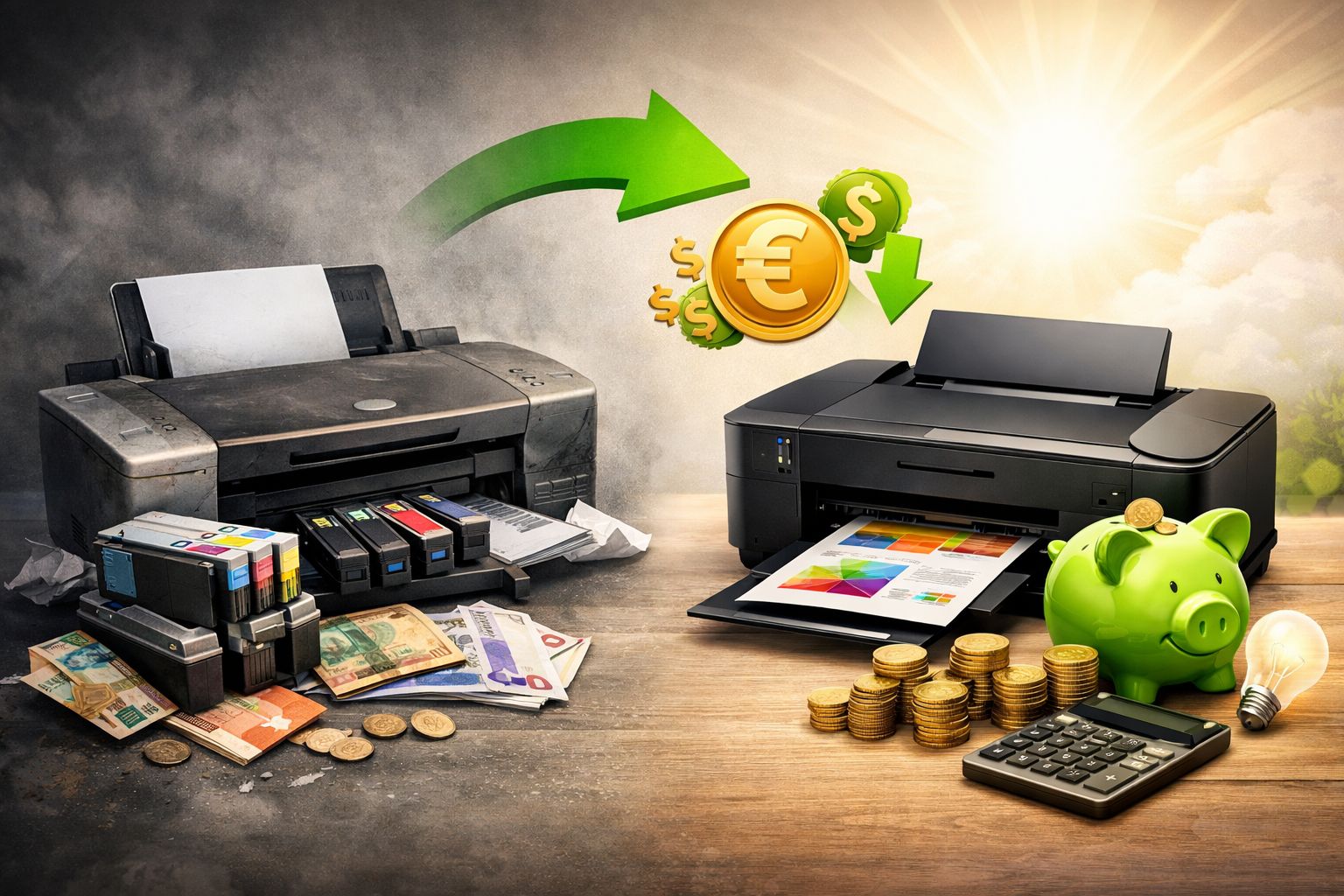
Many users keep paying for expensive ink or toner simply because “the printer still works.” In reality, there are clear cases where replacing the printer is not wasteful, but actually the most cost-effective decision. The question is not whether the printer works, but whether it still makes financial sense to keep it.
When consumable costs exceed the value of the printer
One of the clearest warning signs is when a full set of cartridges or a toner costs as much as—or more than—a new printer. This often happens with older low-cost inkjet models, where ink is expensive and yields are low.
If every replacement costs €40–€60 and only prints a few hundred pages, you are continuously paying to maintain a poor past decision.
When cost per page is unreasonably high
Even if it is not obvious at first glance, cost per page is the most objective indicator. If you are paying €0.06–€0.10 per black-and-white page, you are at a very expensive printing level, especially for frequent use.
In such cases, a laser printer with a lower cost per page can recover its purchase price within months. The difference is not theoretical—it directly affects your monthly budget.
When there are no affordable consumable options
Some printer models are practically “locked” into specific consumables. There are no XL versions, no reliable compatible options, or the available cartridges are limited and expensive.
If every time you search for supplies you only find one expensive option, your printer is restricting your choices. Switching to a model with wide consumable availability gives you immediate cost control.
When your printing needs have changed
Many people buy printers for occasional use and later start printing much more due to remote work, studies, or business needs. An inkjet that was fine for 20 pages a month becomes extremely expensive at 300–500 pages.
When usage changes, the printer should change too. Otherwise, you keep overpaying for something that no longer fits your needs.
When you spend more time than money
Frequent cartridge changes, drying ink, printhead cleaning, and failed prints all come with a time cost. In a professional environment, this translates directly into lost productivity.
If your printer constantly requires attention to function properly, it is not cost-efficient—even if it technically still works.
When the payback period is short
The simplest question is: how long does it take to recover the cost of a new printer through lower cost per page?
If the answer is six to twelve months, then the replacement is not an expense but an investment. After that point, every printed page becomes net savings.
When repairs start to add up
An old printer with expensive consumables and increasing minor issues creates a double cost. Even small failures add up over time and increase total ownership cost.
At this stage, replacement is usually more logical than maintaining equipment that is barely “holding on.”
What to consider when replacing a printer
A replacement only makes sense if it is done properly. The new printer should be chosen based on cost per page, availability of affordable consumables, XL or multipack options, and actual usage needs.
If you simply replace one cheap printer with another similar one, the same problem will repeat.
A printer should not be kept just because it still works. When consumables are expensive, output is low, and cost per page is high, replacement is often the most economical solution.
The right time to change a printer is not visible in the purchase price—it is visible in your monthly spending. When that cost drops significantly with a new printer, the decision becomes clear.


